



Durable Restaurant Plates That Don’t Chip: The 2026 AU Commercial Buying Guide

How much does a single hairline chip on a main course plate actually cost your venue? Beyond the immediate safety risk, a damaged rim sends a silent, damaging message to your guests about the standards of your kitchen. Many hospitality professionals simply accept high breakage rates as a fixed cost of doing business, yet the constant cycle of replacing inferior crockery quietly erodes your profit margins. You deserve a tabletop solution that remains as pristine on its thousandth service as it did on its first.
Finding durable restaurant plates that don't chip requires moving beyond domestic grade aesthetics to understand the material science of professional hospitality. We understand that in a high-volume Australian environment, your plates must survive the heat of a commercial dishwasher and the frantic pace of the pass without losing their lustre. This 2026 buying guide provides the technical insights and selection criteria needed to invest in vitrified porcelain and premium melamine with total confidence.
By the end of this guide, you'll know how to distinguish between marketing claims and true durability. We will explore how professional grade materials reduce your long term overheads, ensure consistent stock management, and maintain the elegant presentation your diners expect. It's time to stop viewing crockery as a disposable expense and start seeing it as a lasting asset for your brand.
Key Takeaways
- Understand why a single chip is more than an aesthetic flaw, representing a genuine health and safety risk and a silent drain on your venue's annual profit margins.
- Learn the technical differences between domestic sets and durable restaurant plates that don't chip, focusing on high-alumina content and the industrial vitrification process.
- Discover how to balance the prestige of fine porcelain with the modern versatility of premium melamine platters for high-volume or outdoor service environments.
- Implement the "Three Points of Contact" rule and professional dishwashing protocols to extend the lifespan of your tableware and significantly reduce mechanical shock.
- Identify the critical criteria for selecting an Australian supplier that ensures consistent stock availability to prevent mismatched or incomplete tabletop presentations.
The True Cost of Chipped Crockery in Australian Hospitality
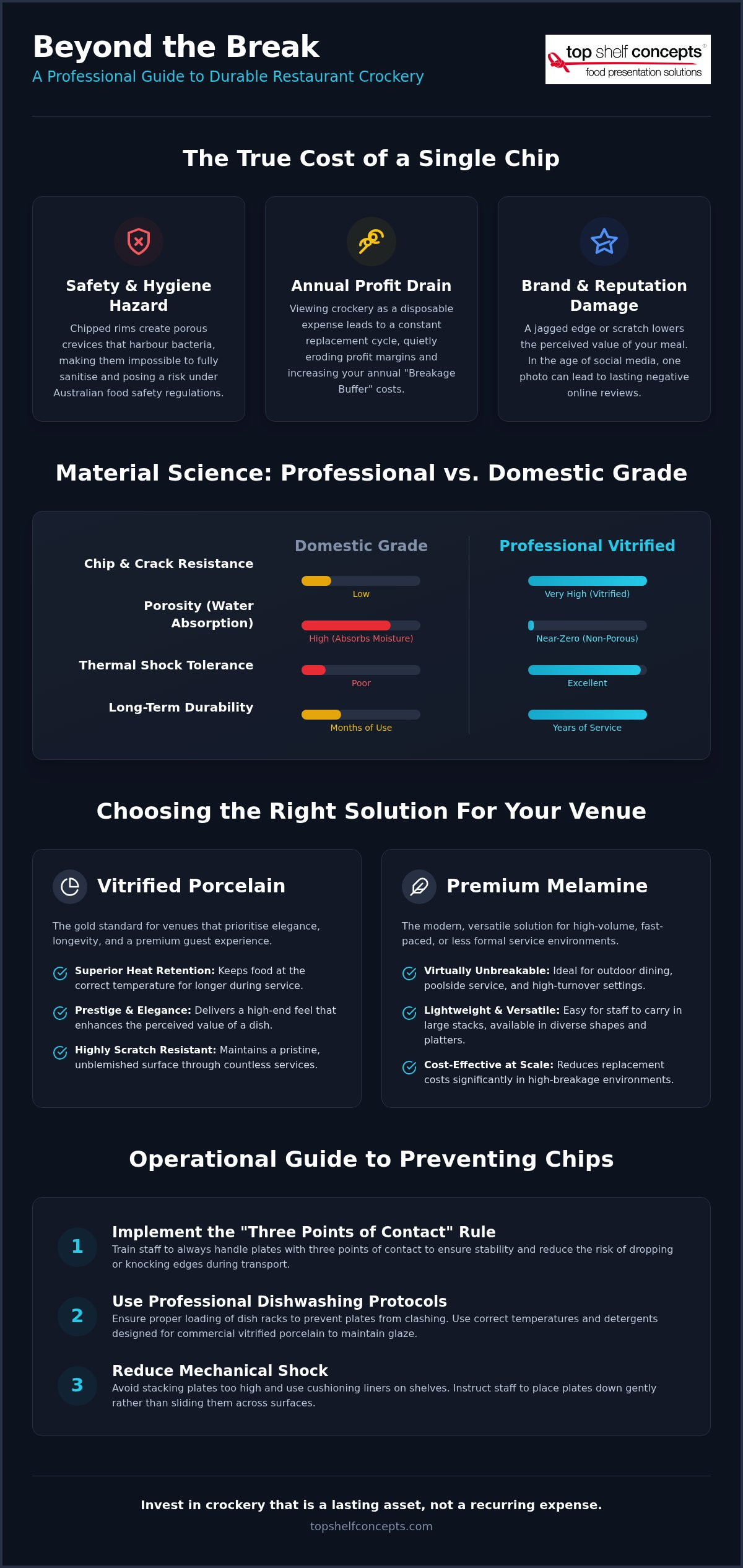
In the high-pressure environment of an Australian commercial kitchen, a single chipped plate is rarely just a cosmetic issue. It represents a systemic failure in procurement that drains capital and compromises service standards. Many F&B managers treat crockery as a consumable expense, yet this "disposable" mindset ignores the compounding costs of frequent replacements. Investing in durable restaurant plates that don't chip isn't merely about aesthetics; it's a strategic move to stabilise overheads and protect your brand's reputation in an era of instant online feedback. When your tableware fails, your guest's perception of your culinary standards often follows suit.
Safety and Hygiene Standards
Public health and safety remain the non-negotiable pillars of the hospitality industry. A chipped rim creates a porous surface where bacteria can thrive, even after a high-temperature wash cycle. These microscopic crevices are impossible to sanitise fully, potentially violating Australian food safety regulations regarding the maintenance of food contact surfaces. Beyond hygiene, the physical risk of ceramic shards entering a dish is a liability no venue can afford to ignore. Professional-grade tableware ensures that your presentation remains safe, sanitary, and compliant with national standards, protecting both your customers and your business from avoidable risks.
The ROI of "Unchippable" Tableware
While the upfront cost of premium porcelain or melamine may be higher, the life-cycle value is incomparable. Cheap alternatives often fail within months of high-volume use, leading to a fragmented inventory and mismatched table settings. High-quality durable restaurant plates that don't chip streamline back-of-house operations by reducing the time staff spend inspecting and discarding damaged stock. This reliability allows for more predictable stock management and ensures your kitchen can focus on culinary execution rather than inventory triage. The Breakage Buffer is the percentage of total stock value lost to damage annually, and reducing this metric is the fastest way to improve your tabletop ROI.
A guest's first interaction with your food is visual. A jagged edge on a platter or a visible scratch on a plate immediately lowers the perceived value of the meal. In the age of social media, a single photo of a chipped plate can reach thousands of potential diners, resulting in negative reviews that are difficult to erase. Moving toward professional-grade solutions ensures your presentation stays consistent, reflecting the prestige and care you put into every dish. By choosing materials designed for the rigours of a commercial pass, you secure the long-term visual integrity of your venue.
Commercial Material Science: Porcelain vs. Vitrified Ceramic
The distinction between a domestic dinner set and professional equipment lies in the molecular structure of the material. For an Australian venue, the search for durable restaurant plates that don't chip begins with understanding vitrification. This process involves firing the ceramic body at extremely high temperatures until the particles fuse into a dense, non-porous, glass-like substance. Unlike standard earthenware or stoneware, vitrified porcelain does not absorb moisture. This prevents the internal expansion that leads to cracking and chipping under the intense stress of a commercial kitchen environment.
Vitrified Porcelain: The Hospitality Workhorse
Vitrification ensures that every piece of tableware can withstand the thermal shock of moving from a cold storage area to a high-heat commercial dishwasher or under a pass heat lamp. This density also contributes to superior thermal efficiency, acting as a reservoir that keeps food at its intended temperature for longer during service. When you select professional porcelain plates, you're investing in a material that maintains its structural integrity despite the mechanical shocks of a busy service. This reliability is why vitrified porcelain remains the gold standard for venues that prioritise both elegance and longevity.
Alumina Reinforcement and Edge Strength
Strength in professional ceramics is often a result of alumina oxide, a compound that acts as a structural skeleton within the porcelain body. High-alumina porcelain is significantly more resistant to impact than standard ceramic, allowing for thinner, more elegant profiles that still offer industrial-level durability. When evaluating your next investment, look for these markers of high-performance construction:
- Reinforced Rolled Edges: Extra material at the rim designed to deflect impact and absorb mechanical shock.
- High-Alumina Content: An internal mineral skeleton that prevents microscopic cracks from spreading across the plate.
- Hard-Glaze Finish: A protective layer fired at intense heat to resist the dulling effects of industrial chemicals and metal cutlery marking.
A factor often overlooked is the value of an edge-chip guarantee. These warranties typically cover the rim of the plate, providing a replacement if the edge chips during normal professional use. It's a clear signal that the manufacturer has confidence in their vitrification and alumina levels. In 2026, choosing durable restaurant plates that don't chip means looking for suppliers who back their material science with these tangible performance promises, ensuring your inventory remains pristine without the need for constant, costly replacements.
Melamine vs. Porcelain: Choosing the Right Solution for Your Venue
Selecting the right material is a balance of operational efficiency and guest expectation. While vitrified porcelain remains the standard for premium tabletop service, the rise of industrial-grade melamine has revolutionised high-volume environments. Managers seeking durable restaurant plates that don't chip often find that a strategic mix of both materials provides the best results. For a deeper technical comparison, consult our Melamine vs Porcelain: 2026 Commercial Crockery Guide. The goal is to maintain a high-end aesthetic while minimising the financial impact of breakage.
Consider the physical toll on your team. A single porcelain platter can weigh several kilograms when loaded, leading to repetitive strain risks during long shifts in large-scale venues. Melamine offers a significant weight reduction without sacrificing the visual weight of the presentation. This lighter profile allows staff to clear tables and restock buffets with greater speed and less fatigue, directly impacting your back-of-house efficiency.
Premium Melamine for Buffets and High-Volume Service
In high-traffic zones, the risk of breakage is at its peak. Modern melamine is virtually impossible to chip or shatter, making it the safest choice for busy buffet lines or outdoor dining settings. The aesthetic has shifted from basic utility to "quiet luxury," with finishes that perfectly mimic organic stone, timber, or artisan ceramic. It's a versatile solution for venues that require durable restaurant plates that don't chip but want to avoid a "canteen" appearance. It's vital to remember that melamine is not suitable for ovens or direct heat sources; it excels in cold displays or room-temperature service where durability is paramount.
Hybrid Approaches: Mixing Materials for Durability
Sophisticated venues rarely rely on a single material. A common 2026 strategy involves using high-alumina porcelain for the guest's individual plate, where the weight and heat retention matter most, while utilising melamine for large display bowls and platters. This keeps the buffet looking lush and consistent without the constant replacement costs of heavy ceramic pieces. You can find more strategies for coordinating these textures in our feature on Mastering the Art of Buffet Display: A Professional Guide for 2026.
By matching colours and textures across different materials, you create a seamless visual experience. This hybrid approach ensures that the touchpoints closest to the guest feel prestigious, while the bulk of the inventory remains rugged enough to withstand the rigours of a high-speed kitchen environment. It's a calculated investment that protects your profit margins and your presentation standards simultaneously.
Operational Guide: Preventing Chips in the Back-of-House
Even the most resilient high-alumina porcelain requires a disciplined operational framework to reach its full life-cycle potential. While procuring durable restaurant plates that don't chip is a vital first step, back-of-house protocols determine exactly how many years those pieces remain in service. Breakage rates are frequently a reflection of staff handling habits rather than material failure. Implementing the "Three Points of Contact" rule ensures that plates are always supported by a hand, a stable surface, and a secure grip, preventing the accidental slips that lead to impact damage.
Educating your team on the value of the venue’s hardware is equally essential. When kitchen staff view tableware as sophisticated equipment rather than disposable items, they handle each piece with greater precision. This cultural shift, combined with rigorous training on proper stacking heights, creates a professional environment where the longevity of your investment is a shared priority. A well-trained team is the most effective defence against unnecessary replacement costs.
Optimising the Dishwashing Cycle
The commercial dishwasher is where most mechanical stress occurs. It's crucial to maintain strict temperature control to prevent thermal shock fractures, which happen when ceramic is subjected to extreme temperature swings too quickly. Additionally, the chemical balance of your cleaning agents matters. Harsh, overly acidic detergents can gradually erode the protective glaze, leaving the body vulnerable to staining and surface scratches. Always ensure you use the correct peg-rack sizing; plates should sit securely without touching their neighbours, eliminating the "clinking" that causes rim damage during the high-pressure wash cycle.
Smart Storage and Transport
Proper storage is often more important than the plate itself when it comes to preventing damage. Utilising dedicated plate dispensers and specialised trolleys reduces the need for manual handling, which is when most accidents occur. Anti-slip matting on prep surfaces and in storage areas also plays a vital role by preventing edge-to-edge contact during transport. Mechanical shock is the sudden physical impact between two surfaces, such as plates clinking in a stack or hitting a bench, which creates microscopic fractures that eventually lead to visible chips.
To protect your overheads and maintain a pristine presentation, you must pair high-quality materials with professional storage solutions. Explore our range of premium tabletop and storage equipment to secure your kitchen's efficiency.
Sourcing the Best Durable Plates in Australia
Procuring durable restaurant plates that don't chip is the final, critical step in your tabletop strategy. For Australian venues, the greatest risk isn't just the initial quality, but the long-term availability of matching stock. If a specific line is discontinued or delayed in international transit, your tabletop consistency suffers. Choosing a local partner ensures that your service remains uniform, even when you need to top up your inventory during peak seasons. Reliability in supply is just as important as the structural integrity of the ceramic itself.
When evaluating suppliers, you must look beyond the price per piece. A cheap plate that requires replacement twice a year is far more expensive than a premium piece that lasts five. Consider the supplier's understanding of the Australian hospitality landscape and their ability to provide a comprehensive suite of solutions, from buffet displays to fine dining porcelain. True value is found in the intersection of aesthetic excellence and a reduced Breakage Buffer.
The Top Shelf Difference: Curation and Quality
At Top Shelf Concepts, we act as a specialised curator for the hospitality sector. Our selection of professional-grade porcelain is chosen specifically to meet 2026 standards for thermal shock resistance and edge strength. We also offer an extensive melamine range, providing high-impact solutions for buffets where traditional ceramic might be too heavy or fragile. For more insights on building a resilient supply chain, read our Sourcing Hospitality Supplies: 2026 Australian Guide.
Our focus is on providing durable restaurant plates that don't chip while maintaining the aesthetic excellence your brand demands. We understand that every venue has unique requirements. This is why we curate materials that bridge the gap between high-volume utility and the "quiet luxury" required for premium food presentation. Our collections are designed to withstand the frantic pace of the Australian pass without losing their sophisticated finish.
Next Steps for Your Venue
The first step toward a more sustainable tabletop is an honest audit of your current breakage rates. Calculate your annual replacement costs to identify exactly where your current inventory is failing. Once you understand the financial drain, you can select a signature style that offers both longevity and a cohesive visual identity. This transition from a "disposable" mindset to a long-term investment is what defines a successful modern venue.
Selecting the right hardware is a complex decision that impacts your staff, your guests, and your bottom line. Contact our experts for a tailored consultation to discuss a full venue fit-out. We will help you navigate our curated collections of porcelain and melamine to find the perfect balance of durability and style for your specific operational needs.
Securing Your Venue’s Competitive Edge
Securing the longevity of your venue's presentation requires a shift from viewing crockery as a consumable to treating it as a strategic asset. By prioritising the material science of vitrified porcelain and high-alumina reinforcement, you ensure your kitchen is equipped with durable restaurant plates that don't chip under the pressure of high-volume service. Combining these superior materials with disciplined back-of-house handling protocols creates a foundation for consistent excellence and significantly reduced overheads.
Top Shelf Concepts stands as Australia’s leading supplier of premium buffet and tabletop equipment, offering an expertly curated range that balances durability with aesthetic brilliance. We are dedicated to supplying the Australian hospitality sector with innovative presentation solutions that help chefs and managers distinguish themselves in a competitive market. It's time to move beyond the frustration of frequent replacements and invest in quality that lasts. Upgrade your venue with our durable, hospitality-grade porcelain and melamine plates. Browse the Top Shelf Concepts range today. We look forward to helping you transform your food presentation into a lasting hallmark of your brand's prestige.
Frequently Asked Questions
What is the most durable material for restaurant plates?
Vitrified porcelain with high alumina content is widely considered the most durable material for traditional dining. This material undergoes high-temperature firing that creates a non-porous, dense body resistant to mechanical and thermal shock. For high-volume buffet environments, premium melamine provides a virtually unbreakable alternative. Both materials are essential components when sourcing durable restaurant plates that don't chip for a professional Australian kitchen.
Do edge-chip guarantees actually cover accidental breakage?
No, edge-chip guarantees specifically cover chips occurring on the rim during normal professional use, such as washing, stacking, or service. They don't typically cover full breakage from being dropped or impact fractures caused by severe misuse. It's vital to read the manufacturer's terms; most require the chipped piece to be returned to the supplier for inspection to ensure the damage falls within the warranty's specific parameters.
Is melamine a suitable alternative to porcelain for high-end restaurants?
Modern melamine is highly suitable for specific high-end applications, particularly for buffet displays or poolside service. Industrial-grade melamine now features sophisticated finishes that mimic the look of organic stone or artisan ceramic with remarkable accuracy. While porcelain remains the standard for individual main course service due to its heat retention and weight, premium melamine platters offer a durable, elegant solution for shared dining and large-scale presentations.
Why do my plates keep chipping in the commercial dishwasher?
Chipping in dishwashers is usually caused by "clinking," which is mechanical shock from plates touching during the wash cycle. Incorrect peg-rack sizing often allows plates to vibrate against each other under high water pressure. Additionally, using excessively harsh detergents can weaken the protective glaze over time. This makes the ceramic body more susceptible to the minor impacts that eventually lead to visible chips on the rim.
How can I tell if a plate is truly vitrified?
A truly vitrified plate will have a zero or near-zero porosity rate, meaning it won't absorb moisture or bacteria. You can often identify professional vitrification by the "ring" test; when lightly tapped, vitrified porcelain produces a clear, high-pitched chime rather than a dull thud. Most reputable commercial suppliers will also provide technical data sheets confirming the firing temperature and water absorption rates of their hospitality-grade collections.
Does the weight of a plate affect its durability?
Weight is not a direct indicator of strength; material composition is far more important. A heavy, thick earthenware plate is often more fragile than a thinner, high-alumina porcelain piece. While a heavier plate might feel more substantial to a guest, true durability in 2026 relies on the density of the vitrified body and the reinforcement of the edges rather than the sheer mass of the ceramic.
What is alumina-reinforced porcelain?
Alumina-reinforced porcelain contains added aluminium oxide, which acts as a structural skeleton within the ceramic body. This mineral reinforcement makes the plate significantly harder and more resistant to impact than standard porcelain. It's the industry standard for creating durable restaurant plates that don't chip, allowing venues to use more elegant, thinner profiles without compromising the lifespan of their inventory in a busy commercial pass.
How often should a restaurant replace its crockery?
There is no fixed timeline, but venues should audit their inventory every six months to identify damaged or mismatched pieces. A high-volume restaurant using domestic-grade plates might face a 50% annual breakage rate, whereas those invested in vitrified, alumina-reinforced collections often see this drop below 10%. Replacing items only when they chip or crack ensures your presentation remains pristine without unnecessary capital expenditure.

