



How to Keep Buffet Food Warm: Professional Guide 2026

What if the secret to a flawless five-star buffet isn't the recipe itself, but the invisible science of thermal precision? You've likely spent hours perfecting a signature menu, only to watch the texture degrade under poorly managed heat or face the looming pressure of strict Australian food safety regulations. Every chef knows the struggle of learning how to keep food warm on a buffet for hours without compromising the integrity of the dish or the elegance of the display.
We believe that professional food presentation should never be a compromise between safety and style. This guide provides the definitive blueprint for maintaining "just-cooked" quality and total HACCP compliance throughout your service. You'll learn to master thermal retention using sophisticated solutions like the Modulite™ Tables System and designer heat lamps. We'll preview the essential techniques for 2026 that allow you to organise a high-performance display that stays safely above 60°C without losing its visual appeal or moisture. It's time to ensure your guests enjoy a premium experience from the first plate to the very last.
Key Takeaways
- Ensure 100% compliance with Australian safety standards by maintaining a consistent internal temperature above 60°C to bypass the bacterial danger zone.
- Master how to keep food warm on a buffet for hours by integrating professional heat lamps and induction systems that balance thermal science with high-end aesthetics.
- Utilise the "batching" method and pre-heated serving vessels to maintain perfect food texture and prevent the quality loss associated with large-scale refills.
- Create a seamless, luxury display using SkyRize risers and Modulite™ tables to hide technical components while adding essential vertical dimension to your buffet.
- Navigate the complex 2-hour/4-hour rule with confidence, ensuring your venue meets every regulatory requirement without sacrificing the guest experience.
The Science of Thermal Retention in Professional Buffets
Professional buffet service isn't just about heat; it's about thermal retention. This is the precise ability of a system to keep food at a steady internal temperature, specifically staying above 60°C. In a commercial environment, you aren't trying to continue the cooking process. You're trying to pause it. This distinction is vital. Holding food requires a delicate balance that avoids the temperature danger zone while preventing the overcooking that ruins texture. If your equipment is too aggressive, a delicate barramundi fillet becomes tough in minutes. If it's too weak, you risk a safety breach.
Ambient conditions often sabotage even the best setups. Air conditioning vents or open doors create convection currents that strip heat from the surface of your dishes. Understanding how to keep food warm on a buffet for hours means accounting for your venue's specific airflow and choosing vessels that resist rapid cooling. Porcelain is a classic choice for its high thermal mass, meaning it stays hot once pre-heated. High-quality melamine is also an excellent insulator. While metal conducts heat quickly, it also loses it just as fast. Melamine acts as a thermal barrier, keeping the heat inside the food rather than letting it escape into the table or the surrounding air.
Conduction, Convection, and Radiation: A Chef’s Primer
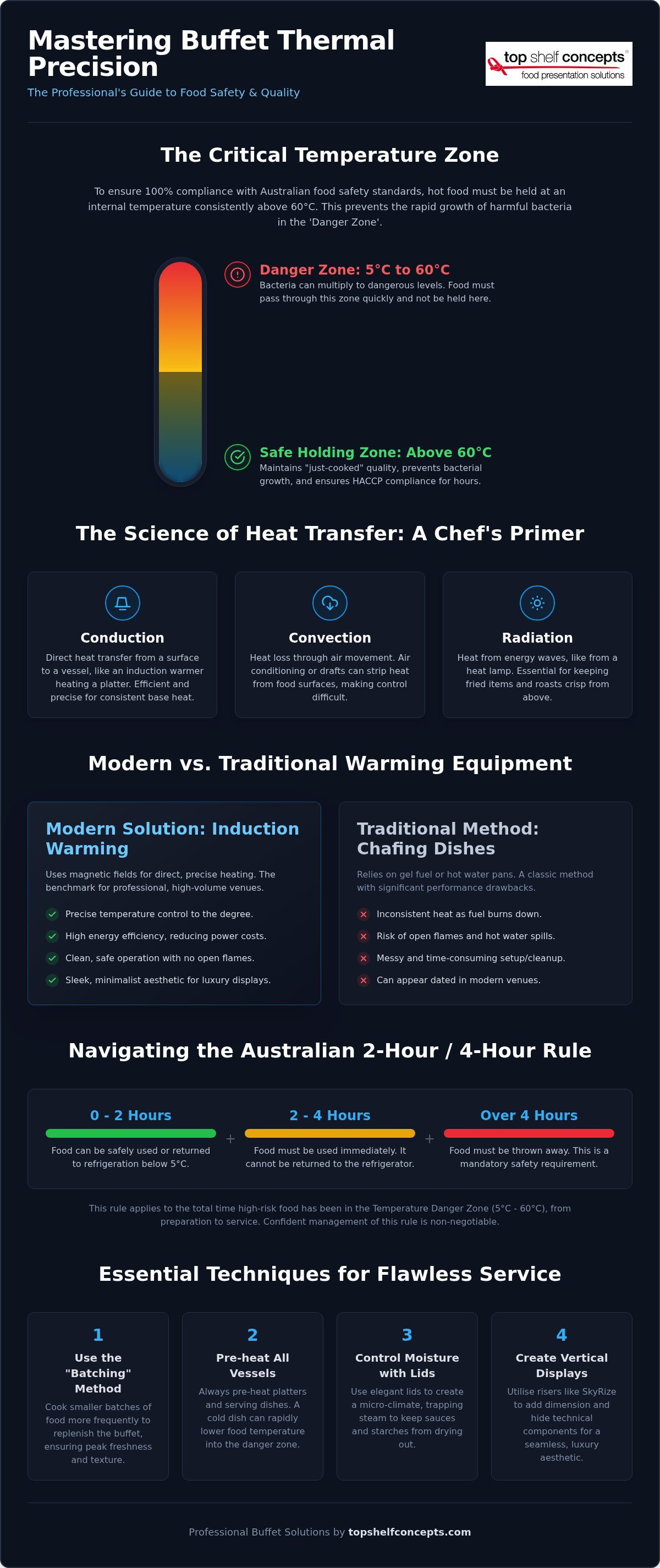
Heat transfer happens in three specific ways on your line. Conduction occurs when heat moves through direct contact, such as an induction warmer sitting beneath a porcelain platter. It's efficient and direct. Radiation, however, involves energy waves. This is where commercial heat lamps shine. They provide targeted heat from above, which is essential for carving stations or fried items that need to stay crisp. Convection is the most difficult to control. It's the movement of hot air away from the food. If your venue has high ceilings or heavy traffic, you're constantly losing heat to the room. Managing these currents is a fundamental part of learning how to keep food warm on a buffet for hours without turning your proteins into leather.
Why Moisture Control is the Key to Quality
Heat and evaporation are inseparable. Without a barrier, the water content in your food turns to steam and escapes, leaving the dish dry and salty. Using elegant lids or covers isn't just a hygiene choice; it creates a micro-climate that recirculates moisture. This maintains the dish's integrity for much longer than an open pan ever could. It's particularly important for sauces and starches that thicken as they lose hydration. Thermal equilibrium in a 4-hour buffet service is achieved when the rate of heat supplied by your equipment perfectly matches the rate of heat lost to the surrounding environment.
Selecting Professional Warming Equipment for Your Venue
Selecting the right hardware is the foundation of any successful service. While domestic hacks suggest using slow cookers or toaster ovens, these lack the precision and safety required for high-volume commercial environments. Understanding how to keep food warm on a buffet for hours requires equipment that can withstand the rigours of a busy dining room while maintaining a sleek, professional aesthetic. Traditional chafing dishes, while reliable, often struggle with temperature fluctuations as the fuel burns low. In contrast, modern induction technology offers a level of control that ensures your signature dishes remain at their peak from the first guest to the last.
The Rise of Induction Warming
Induction warming has transformed the professional buffet landscape. By using magnetic fields to heat the vessel directly, these systems provide precision temperature control to the exact degree. This eliminates the unpredictability of open flames and the mess of hot water pans. For high-volume Australian venues, the energy efficiency of induction is a significant advantage, reducing both power costs and ambient kitchen heat. It's a cleaner, safer, and more sophisticated way to manage your thermal requirements without the clutter of traditional setups. These systems ensure your dishes stay consistently above 60°C, meeting mandatory Australian safety standards with ease.
Strategic Use of Radiant Heat Lamps
Texture is often the first casualty of heat retention. While a covered dish preserves moisture, it can quickly turn crispy items soggy. This is where commercial heat lamps become indispensable. By providing radiant heat from above, they maintain the 'crunch' of roasted meats and fried delicacies. Whether you choose decorative pendant lamps to enhance your decor or functional freestanding units for a carving station, proper height adjustment is essential. Setting the lamp at the correct distance ensures maximum thermal efficiency without drying out the product.
Outdoor catering presents unique challenges, particularly regarding wind and power access. While fuel-based burners are portable, they are susceptible to breezes and provide uneven heat. Electric warming mats offer a more consistent alternative if power is available. Modular systems allow for a flexible layout where heating elements are integrated seamlessly. This modularity ensures that every section of a large buffet receives the exact amount of heat it requires. When you are planning how to keep food warm on a buffet for hours, this level of curated control is what separates a standard buffet from a premium dining experience. To elevate your next event, consider exploring our range of professional buffet equipment designed for the modern hospitality leader.
Step-by-Step: Managing a Buffet for Extended Service Hours
A professional buffet is a living operation. It requires constant oversight to maintain the delicate balance between culinary quality and food safety. While many venues focus solely on the heating elements, the process of managing the food itself is what determines the final guest experience. Understanding how to keep food warm on a buffet for hours starts with a disciplined workflow that begins in the kitchen and continues until the final plate is cleared. Success is found in the details of the transition.
Preparation and Pre-Heating Protocols
The most frequent error in buffet service is placing piping hot food into cold serving vessels. This results in an immediate temperature drop as the vessel absorbs the food's thermal energy. Utilise warming drawers to bring porcelain plates and melamine platters to temperature before they reach the floor. Implement a strict 15-minute rule; ensure all induction warmers and heat lamps are at their peak operating temperature at least a quarter-hour before service begins. This creates a stable thermal environment, ensuring the food stays at or above the mandatory 60°C from the moment it's plated.
Organising a seamless kitchen-to-buffet transport chain is equally critical. Every second a tray spends in a draughty corridor is a second it loses vital heat. Use insulated carriers or covered trolleys to bridge the gap between the oven and the display area. This precision ensures that thermal equilibrium is maintained throughout the transition, preventing the "thermal shock" that can degrade delicate proteins.
Active Management During Service
Once service is live, the strategy shifts to active maintenance. The "Batching" strategy is a hallmark of elite catering. Instead of one massive tray that sits for an hour, use smaller, frequent refills. This keeps the product visually fresh and ensures the core temperature remains consistent. High-quality commercial serving utensils also play a subtle yet vital role. Heavy-duty steel or insulated handles minimise heat transfer away from the food during the plating process, keeping the heat where it belongs.
Regular stirring is essential for sauces, soups, and wet dishes. Without movement, heat settles at the bottom. This leads to scorching while the surface develops a cold, unappealing skin. Professionals should also log temperatures every 30 to 60 minutes. This provides a record of accountability and ensures you're navigating the 2-hour/4-hour rule with absolute precision. If a dish begins to look tired, don't just add more heat. Use "refreshing" techniques, such as a light mist of stock or a quick toss, to restore the vibrant texture guests expect from a premium venue.
Food Safety Standards: Navigating the Danger Zone in Australia
Precision is not optional in the Australian hospitality sector. The Australia New Zealand Food Standards Code mandates that potentially hazardous food must be kept at or above 60°C to prevent the rapid growth of foodborne pathogens. This range, known as the danger zone, exists between 5°C and 60°C. Bacteria thrive here. When you are strategising how to keep food warm on a buffet for hours, you aren't just protecting the flavour; you're protecting your guests from a portion of the $3 billion annual cost of foodborne illness in Australia. Relying on guesswork is a significant risk. Every professional station must be equipped with digital probe thermometers to conduct regular internal temperature checks at the thickest part of the dish.
Compliance requires more than just meeting the temperature. It requires proof. Health inspectors expect to see a meticulous temperature log that documents your monitoring intervals. This record serves as your venue's primary defence during an audit. It demonstrates a commitment to rigorous safety standards and professional accountability. Under the mandatory Standard 3.2.2A, businesses must also ensure they have a designated food safety supervisor to oversee these critical processes. In Australia, any potentially hazardous hot food that has been held between 5°C and 60°C for a total of four hours or more must be discarded immediately to ensure guest safety.
HACCP Compliance for Buffet Service
A robust Hazard Analysis Critical Control Point (HACCP) plan identifies the warming stage as a Critical Control Point (CCP). This is the final barrier before the guest consumes the product. Staff training should focus on identifying these points and knowing exactly which corrective actions to take if a dish falls below 60°C. High-risk foods, such as seafood, poultry, and dairy-based sauces, require even more frequent monitoring. These items are more susceptible to contamination and require the most stable thermal environments. Understanding how to keep food warm on a buffet for hours means knowing which dishes need the most direct heat and which can be managed with radiant solutions.
The Legal Implications of Food Temperature
The legal consequences of a safety breach can be devastating for a premium venue. Beyond the immediate fines, the reputational damage is often permanent. Rigorous safety standards are your best insurance policy. Professional warming equipment simplifies this compliance by providing the stability that domestic or low-end gear cannot. Modern induction systems and heat lamps are designed to hold temperatures within a narrow, safe margin, reducing the constant need for manual adjustments. To ensure your venue meets these rigorous requirements with style, explore our range of premium buffet and catering equipment. Investing in the right hardware is the most effective way to guarantee both culinary excellence and total regulatory peace of mind.
Elevating the Experience: Aesthetic Warming Solutions
Functionality should never come at the expense of style. In the premium hospitality sector, the equipment used to maintain temperature must be as sophisticated as the cuisine it protects. A masterful buffet display integrates technology so seamlessly that the guest only notices the elegance of the presentation. When you're solving how to keep food warm on a buffet for hours, the visual clutter of power cords and industrial bases can often shatter the illusion of luxury. By utilising SkyRize display risers, you create a multi-level landscape that draws the eye upward while cleverly concealing the technical elements required for induction mats or hot plates. This verticality adds drama and ensures every dish is accessible and perfectly showcased.
The choice of finishes plays a vital role in venue cohesion. Whether your decor calls for the warmth of brushed copper, the contemporary edge of matte black, or the timeless prestige of polished chrome, your warming units should feel like a deliberate part of the interior design. There's also a powerful psychological component at play. The amber glow of a visible heat lamp acts as a sensory beacon. It signals "fresh and hot" to the guest before they even reach for a serving utensil, creating an immediate sense of comfort and quality that enhances the overall dining experience.
Modular Layouts for Flow and Function
Flexibility is the hallmark of modern event planning. The Modulite™ tables system allows you to organise dedicated hot zones that are physically separated from your chilled stations. This strategic placement prevents thermal interference, ensuring your salads stay crisp while your proteins remain succulent. It also manages guest flow by preventing congestion around heat sources, allowing for a relaxed and orderly dining pace. Combining hot and cold elements on a single modular line requires precision, but with the right layout, you can maintain perfect thermal integrity across the entire display.
The Final Touch: Premium Tabletop Elements
A guest’s perception of warmth begins the moment they touch their plate. Our melamine vs porcelain dinnerware guide highlights how material choice impacts heat retention and the tactile experience of the meal. Porcelain offers a classic, weighted feel that holds pre-heated temperatures beautifully, while premium melamine provides incredible durability and insulation. To truly distinguish your service, consider using custom branding irons for signature touches on warm brioche or roasted items. This creates a multi-sensory experience where light, heat, and aroma converge, proving that mastering how to keep food warm on a buffet for hours is as much about the art of the display as it is about the science of the heat.
Mastering the Art of the Hot Buffet
Successful service is a delicate choreography of regulatory compliance and high-end presentation. By mastering the science of thermal retention and selecting precision equipment, you ensure your signature dishes remain safely above 60°C without sacrificing moisture or texture. Learning how to keep food warm on a buffet for hours is more than a technical requirement; it's the foundation of a premium guest experience that reflects the prestige of your venue. From the vertical elegance of SkyRize risers to the steady heat of induction systems, every element should work in harmony to protect your culinary integrity.
Top Shelf Concepts is Australia’s leading supplier of premium hospitality equipment, specialising in Red Dot award-winning designs trusted by top-tier Australian hotels and caterers. We provide the tools you need to balance strict HACCP standards with "quiet luxury" aesthetics. Explore our range of professional buffet warming solutions to find the perfect match for your venue's decor and operational needs. You now have the blueprint to transform your buffet into a sensory masterpiece that remains as vibrant at the final hour as it was at the first. It's time to elevate your display with confidence.
Frequently Asked Questions
What is the safe temperature for keeping food warm on a buffet in Australia?
In Australia, the mandatory safe temperature for holding hot food is 60°C or higher. This is a strict requirement under the Australia New Zealand Food Standards Code to prevent bacteria from multiplying in the danger zone. You should use a digital probe thermometer to verify the internal temperature of your dishes regularly. Maintaining this level is the most effective strategy for how to keep food warm on a buffet for hours while ensuring guest safety.
How long can food stay out on a buffet before it becomes unsafe?
Australian food safety follows the 2-hour/4-hour rule. Food can be held between 5°C and 60°C for up to two hours and still be returned to the fridge. Between two and four hours, the food must be consumed immediately and cannot be stored. Once the four-hour mark is reached, the food is considered potentially hazardous and must be discarded. Precision warming equipment helps you stay safely outside these time-based risks during extended service.
Do heat lamps actually keep food warm or just the surface?
Commercial heat lamps utilise radiant energy to maintain temperature from the top down. While they are exceptionally effective at preserving the "crunch" of fried or roasted items, they primarily target the surface. For a complete thermal solution, lamps should be paired with induction bases or hot plates that provide bottom-up heat. This combination ensures the entire dish remains at a consistent temperature rather than just the top layer, preventing cold spots in deeper vessels.
Can I use a slow cooker for a professional catering event?
Slow cookers are domestic appliances and aren't suitable for professional catering environments. They lack the rapid recovery times and precise temperature controls required to meet Australian commercial safety standards. Using residential gear in a high-volume venue looks unprofessional and poses a significant risk of food falling into the danger zone. Instead, invest in commercial induction warmers or modular systems designed to handle the rigours of professional service and high-end presentation.
What is the best way to keep bread and rolls warm without them going hard?
The key to keeping bread and rolls supple is controlled humidity and low, steady heat. Using a dedicated bakery display drawer or a warming cabinet prevents the starch from crystallising and turning the bread hard. Avoid high-intensity direct heat which strips moisture. If you don't have a humidity-controlled drawer, keep rolls in a basket lined with a clean cloth and placed near a gentle, indirect heat source to maintain a soft, fresh texture.
How do I stop pasta and rice from drying out on a buffet?
Pasta and rice dry out quickly due to evaporation, so moisture management is essential. Use shallow pans and lids to trap steam, and stir the contents frequently to redistribute the heat and hydration. Adding a small amount of stock, butter, or oil during service can help "refresh" the grains and prevent them from clumping. Smaller, more frequent refills are always superior to leaving a large tray of starch sitting under a heat source for too long.
Is induction warming better than traditional chafing fuel?
Induction warming is far superior to traditional chafing fuel in a professional setting. It offers pinpoint temperature accuracy, better energy efficiency, and eliminates the hazards of open flames and carbon monoxide fumes. Induction systems provide a cleaner aesthetic for luxury displays and don't require the constant monitoring or replacement that fuel cells do. It's the most reliable method for how to keep food warm on a buffet for hours without the unpredictability of burning gel or tea lights.
What should I do with buffet food that has been out for more than 4 hours?
Any potentially hazardous food that has been held in the danger zone for more than four hours must be thrown away. This is a non-negotiable legal requirement in Australia to prevent food poisoning. Even if the food looks and smells fine, the bacterial load may have reached dangerous levels. Rigorous documentation in your temperature logs will help you track these timings accurately, ensuring you never serve compromised items to your guests.

